Historical La-Croix-de-Pallières concession near Saint-Félix-de-Pallières
Umicore recognizes the complexity of former mining sites and takes its responsibilities seriously within the applicable legal framework. We remain committed to working closely and constructively with the competent authorities to identify appropriate, effective and sustainable solutions that reduce exposure to historical mining residues.
Mining history
Mining activity near the town of Saint-Félix-de-Pallières began in the 19th century, focusing on extracting zinc and related metals from the rich subsoil.
In 1913, the French state granted the La-Croix-de-Pallières mining concession to the Société des Mines et Fonderies de Zinc de la Vieille-Montagne, which later became part of Union Minière, the predecessor of Umicore.
The extracted metals were used to produce refined zinc to protect steel from corrosion. This helped ensure the durability of many applications in construction, transportation, and manufacturing such as road equipment, fences, bridges, gutters, and roofing, and thereby supported industrial expansion.
In 1971, Union Minière decided to close the mines and subsequently began the process of relinquishing its mining concessions. It carried out works to secure the site, and the French state accepted the return of the last concession in 2005.
A historical mining area covered by nature
Unlike other operations in the region, no structures have been preserved at the La-Croix-de-Pallières concession sites, almost erasing its mining past. Over the past 50 years, forests and vegetation have partially reclaimed the areas, creating a misleading impression of a recreational space.
However, it is important to remember that this site remains a former mining area. For centuries -- since roman times -- and under many different owners, its primary purpose was the extraction of minerals. Visitors to this historical mining area can still be exposed to elevated concentrations of residual metals such as lead, zinc, and cadmium.
The objective of the remediation measures is to reduce exposure to residues from former mining activity and contribute to the long-term protection of people and the environment, under the supervision of the competent authorities.
The rehabilitation of former mining sites is a long-term process. Each site has specific technical, environmental and regulatory characteristics, which require detailed studies, expert assessments and validation by the competent authorities before work can be carried out.
Past and recent remediations at La-Croix-de-Pallières
La Digue – Stabilized, contained and controlled tailings
Umicore closed the former mining area in full compliance with the laws and requirements of public authorities at the time, as part of the process of returning the concessions to the state.
Initially, it redeveloped and secured the old mining installations, which included demolishing buildings, filling in openings, and restoring the site.
The initial containment of the La Digue tailings dam occurred in 1996. This involved installing a drainage system with a ditch surrounding the dam and a conduit running through it to prevent surface water from percolating into the old dam. The tailings dam was completely covered with a clay layer, reshaped, and covered with a 30 to 50 cm layer of vegetated soil to protect it and integrate it into the landscape.
In 2016, in cooperation with the State, Umicore began additional work to reinforce the containment of the tailings dam. This included restoring eroded areas, replanting vegetation, and installing ripraps to restrict access to the site.
Under the supervision of the Regional and Interdepartmental Directorate for the Environment, Planning and Housing (DREAL), which reports to the Prefect, Umicore commissioned an in-depth geotechnical study. Based on the recommendations from this study, Umicore proceeded in 2021 with the complete replacement of the dam cover to ensure proper containment of the tailings for the years to come.
This work was completed in 2023, and the site has since been fully fenced off from the public.
The tailings dam is located on a parcel that is subject to use easements. Apart from the tailings dam, Umicore does not own the land within the perimeter of the former mine.
At least four times a year, a specialist engineering company inspects the tailings dam as part of an ongoing prevention program in collaboration with the relevant authorities. The monitoring consists of checking the integrity of the containment systems, particularly the drainage system, the vegetation cover, and the erosion protection measures.
All the work was carried out under the supervision of the State, in accordance with the provisions of Prefectural Order No. 30-2020-06-24-002 dated 30 June 2020.


Issart – Safe residue removal and new vegetation
In consultation with the relevant government departments, a proposal for the management of the mining residues present in the Issart area was submitted in 2019.
Following feasibility studies and further investigations in 2023, the State in the Spring of 2024 approved the proposed remediation solution.
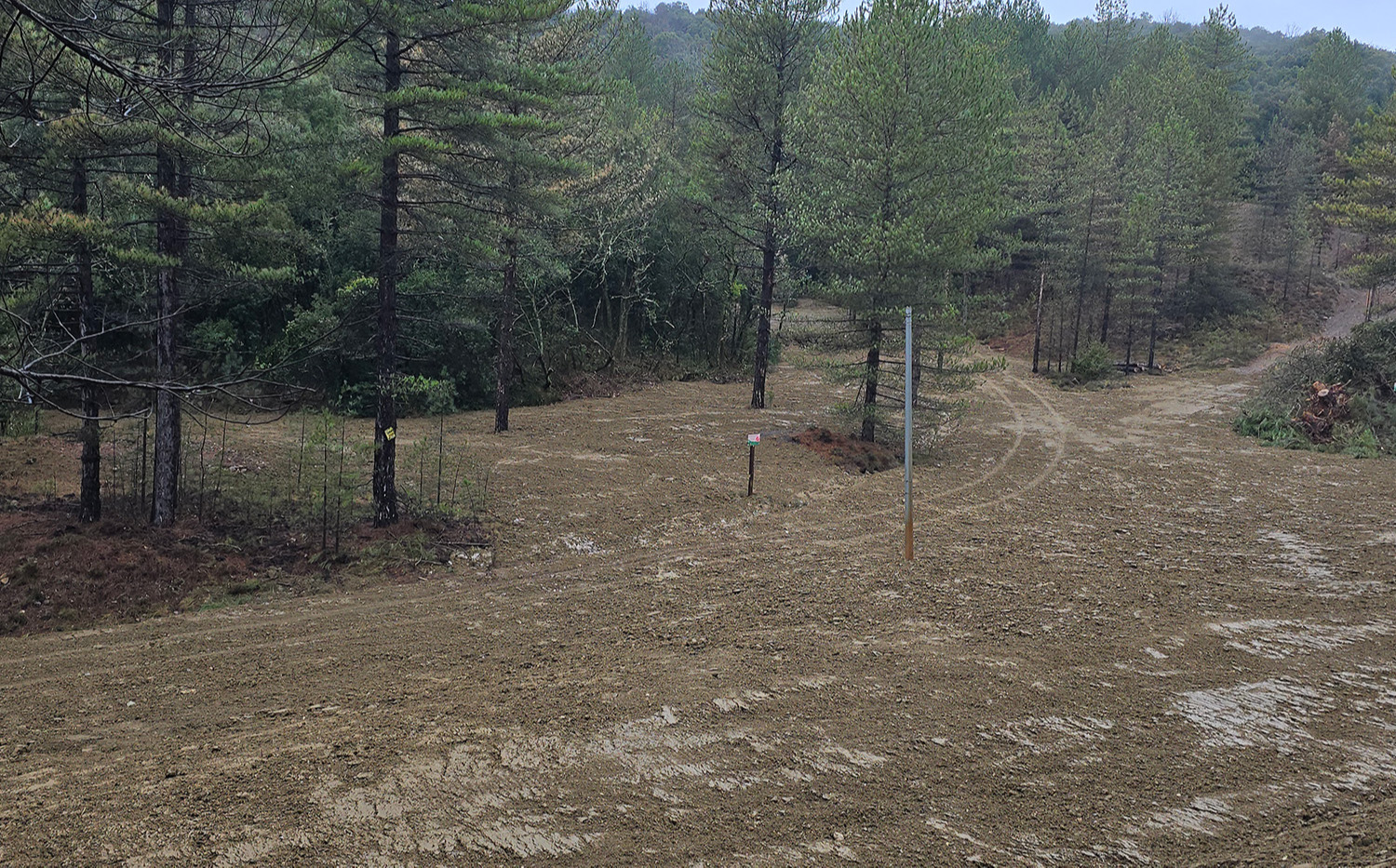
The remediation work consisted of removing the residues present on the site. The materials were transported to an approved treatment facility, where they underwent stabilization and storage treatment. Subsequently, the treated Issart areas were backfilled with clean materials of controlled origin. The area was vegetated by hydroseeding to ensure uniform and rapid growth.
The work began at the end of October 2024 and was completed towards the end of January 2025. It occurred in accordance with the provisions of Prefectural Order No. 2018-11-072 of 29 November 2018.
Shaft No.1 – Ensured safety pending a permanent solution
Shaft No. 1, near the Issart area, is a former mining structure located within the historical mining perimeter of Saint-Félix-de-Pallières. To prevent any immediate risk, the entrance to the shaft is currently closed off by a metal decking laid on joists. This temporary solution was installed on Umicore's initiative and in agreement with the local council, pending a permanent solution.
Umicore has consistently recommended a permanent safety solution in line with the ‘Guide to good practice for securing mining structures opening to the surface ’ (29 June 2012, ref. DRS-12-126117-07379A) published by the French National Institute for Industrial Environment and Risks (INERIS). INERIS is a public institution under the supervision of the Ministry of the Environment and recognized for its expertise in industrial and mining risk prevention.
In the short term, Umicore intends to install a permanent safety solution.
Ongoing and future projects at La-Croix-de-Pallières
GFA de la Gravouillère – Tailings stabilisation pending authorization
For the GFA de la Gravouillère Haldes site, located opposite La Digue, Umicore has proposed an on-site materials management solution similar to the approach implemented at La Digue. The remediation plan includes stabilizing the slopes, installing a protective surface cover, and measures to manage rainwater.
Umicore’s remediation solution was presented to stakeholders during the Monitoring and Information Committee (CSI – Comité de Suivi et d’Information) in 2020, 2021, 2023 and 2025. During these sessions, Umicore shared the management plan and the post-mining expert’s assessment of the tailings treatment on the GFA de la Gravouillère plot. The solution received formal approval through prefectural decrees issued in October 2023 and January 2026.
Pending the necessary regulatory authorizations, work will begin in the second half of 2026 and is expected to last about six months.
Joseph mine – Further assessments required
The Joseph mine used to be part of the former Valleraube concession and was mined for lead and pyritic iron ore. This former mining gallery was closed in 1955, and the concession returned to the state in the early 2000s.
Located in an area with difficult topography and limited accessibility, the site requires further technical studies. These studies continue throughout 2026. The results will be submitted to the government authorities to determine the appropriate solution for the site.